
February 20, 2026
Hegel’s Relationship to Shakespeare’s Hamlet and Macbeth
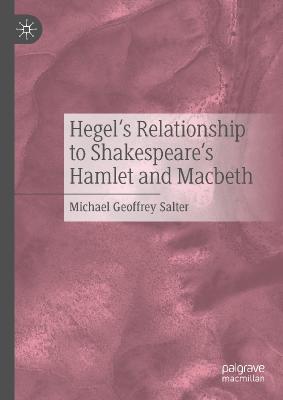
Hegel’s Relationship to Shakespeare’s Hamlet and Macbeth | 8.58 MB
Title: Hegel’s Relationship to Shakespeare’s Hamlet and Macbeth
Author: Michael Geoffrey Salter
Category: Nonfiction, Religion & Spirituality, Philosophy, Aesthetics, Fiction & Literature, Literary Theory & Criticism
Language: English | 435 Pages | ISBN: 3032094453
Description:
This book explores how Hegel, who had studied Shakespeare first as a schoolboy and then continued to cite him throughout his academic career, responded to the challenges of extracting deep philosophical significance and previously unnoticed implications from this playwright’s tragedies, especially Hamlet, Macbeth, Romeo and Juliet and King Lear. More specifically, it addresses how Hegel interprets the contrast between the character Hamlet, as the first truly modern individual, with Macbeth, who was rooted in a superstitious mindset regarding witches’ prophecies of his fate and the supernatural more generally. This contrast, Hegel argues, illustrates the transition from the ideological characteristic of a feudal social order to an early modern one, while illustrating the inner tensions and contradictions of the latter’s extreme individualism with which we continue to grapple in today’s world.
Hegel’s Relationship to Shakespeare’s Hamlet and Macbeth shows how Hegel employed Shakespeare’s imaginary to delve into ideas of self-awareness, freedom, individuality and the recognition of human mortality and finitude. The book is essential reading for all scholars, researchers and advanced students of the thought of G.W.F. Hegel. It is also of interest to scholars of the work of William Shakespeare, especially those focussing on the tragedies.
This book explores how Hegel, who had studied Shakespeare first as a schoolboy and then continued to cite him throughout his academic career, responded to the challenges of extracting deep philosophical significance and previously unnoticed implications from this playwright’s tragedies, especially Hamlet, Macbeth, Romeo and Juliet and King Lear. More specifically, it addresses how Hegel interprets the contrast between the character Hamlet, as the first truly modern individual, with Macbeth, who was rooted in a superstitious mindset regarding witches’ prophecies of his fate and the supernatural more generally. This contrast, Hegel argues, illustrates the transition from the ideological characteristic of a feudal social order to an early modern one, while illustrating the inner tensions and contradictions of the latter’s extreme individualism with which we continue to grapple in today’s world.
Hegel’s Relationship to Shakespeare’s Hamlet and Macbeth shows how Hegel employed Shakespeare’s imaginary to delve into ideas of self-awareness, freedom, individuality and the recognition of human mortality and finitude. The book is essential reading for all scholars, researchers and advanced students of the thought of G.W.F. Hegel. It is also of interest to scholars of the work of William Shakespeare, especially those focussing on the tragedies.
DOWNLOAD: